Thank you for taking the time to donate blood. For the best post-donation experience, we recommend following these guidelines.
Before you leave the donor center or blood drive, please remember to:
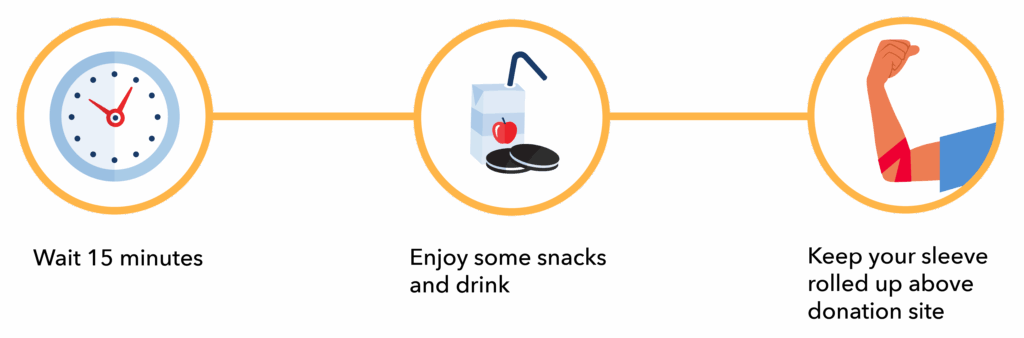
After you go, please be sure to:
Complete donor care guidance
Immediately after donating
- If you begin to feel dizzy, lightheaded, nauseous, or otherwise unwell, inform a staff member immediately
- Wait in the cafe for at least 15 minutes after your donation
- If your diet permits, eat a salty snack
- Keep your sleeve rolled above your elbow until you are ready to leave the cafe
- Should bleeding occur, raise your arm and apply pressure until bleeding stops
- If you need to use the restroom while in the cafe, please notify a staff member
For the remainder of the day
- Keep your bandage on and dry for at least 6 hours
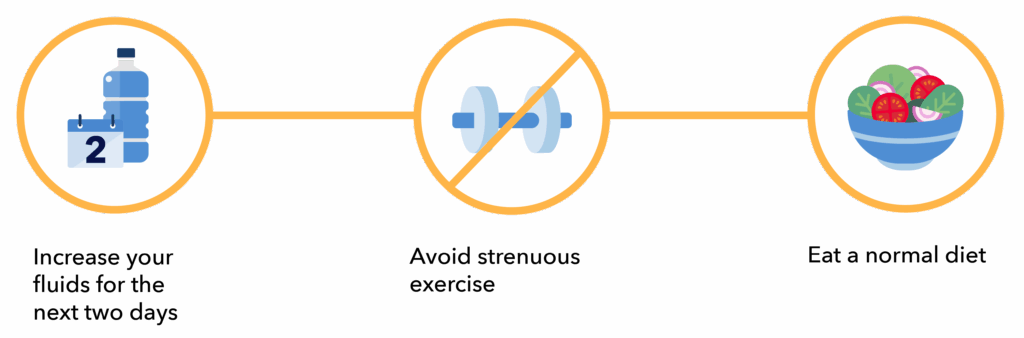
- Avoid heavy lifting, vigorous exercise, and standing for long periods
- Eat a well-balanced diet
- Avoid alcoholic beverages until after you’ve eaten a meal and had a nonalcoholic beverage
- If you smoke, wait for at least 2 hours after your donation
- If you feel weak, faint, lightheaded, nauseous, or sweaty at any time, sit down and place your head between your knees or lie down with your feet elevated until assistance arrives and/or the feeling passes. Intermittent coughing may help you feel better while you remain seated
Going forward
- Over the next 2 days, in addition to your regular water intake, drink at least four additional 8-oz servings.
- Avoid aspirin for at least 48 hours after donation. You may take ibuprofen or other nonsteroidal anti-inflammatory medications (NSAIDs).
- If you develop a bruise or have pain:
- Day 1: apply a cold pack or ice to the area 3-4 times a day for 10-15 minutes at a time
- Day 2: apply a warm compress or alternate cold and warm compresses
- If you donate two or more times a year, consider increasing your intake of iron-rich foods and/or taking an over-the-counter iron supplement. See below for additional information about the role iron plays in blood donation.
Complications to monitor for
While uncommon, possible post-donation complications could include:
- Bruising, nerve damage, or infection at puncture site
- Anxiety
- Feeling warm or cold
- Nausea or vomiting
- Muscle spasms
- Dizziness, fainting, or loss of consciousness. Injuries from falls following dizziness or fainting may also occur
Please contact us if…
- You have fever, chills, or diarrhea within 24 hours of donation
- Anyone in your household tests positive for HIV within 3 months
- Anyone in your household tests positive for hepatitis within 3 months
- You are diagnosed with West Nile Virus within 4 months
- You have a fever with headache or other symptoms suggestive of West Nile Virus within 14 days
- You recall an illness or treatment for West Nile Virus within 4 months
- You wish to alert us of any other history that could affect blood safety
Questions or concerns?
If you experience any of these post-donation symptoms or have other questions regarding your donation or deferral, please contact us at:
Phone: 800-688-0900
For after hours: 212-699-5233
Our regular office hours are Monday-Friday, 9:00AM-5:00PM ET
If you feel your blood should not be given to a patient or if you experience signs or symptoms of illness, call 800-688-0900.
For general questions or comments, call 800-933-2566.